Signboard Type Guide: Which Sign Type is Right for Your Business?
Not all signboards are built the same — and the right sign type depends on where it goes, what it needs to communicate, and the environment it operates in. This guide covers the nine main sign types that A&T fabricates, with a breakdown of how each one is built and where it works best.
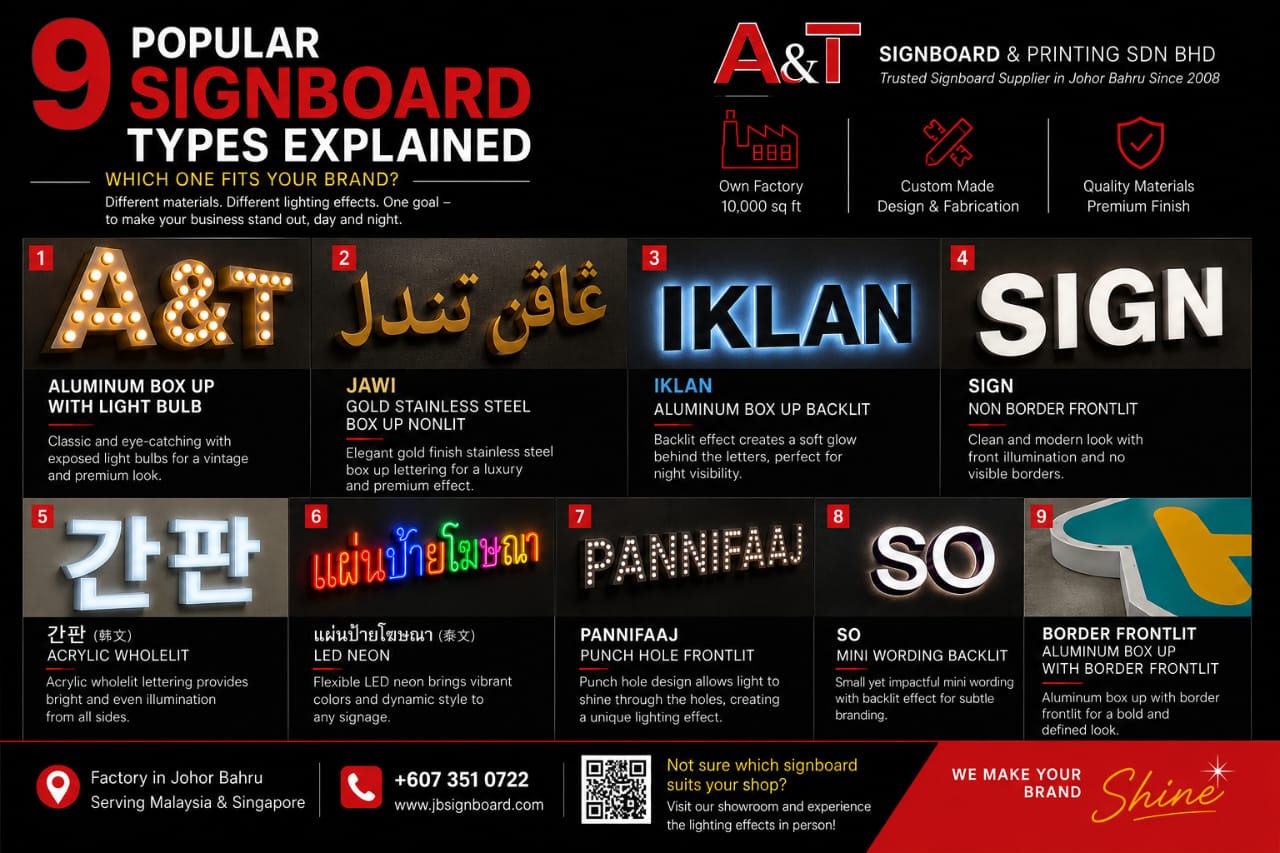
The 9 Sign Types — What They Are and Where They Work
1. Aluminium Box-Up with Light Bulb
Indoor
Aluminium box-up lettering fitted with exposed Edison-style bulbs on the face of each letter. The bulbs are the light source and the visual feature at the same time — producing a warm, decorative glow that reads as intentional and premium rather than purely functional.
Indoor office reception areas, meeting rooms, and rest areas where ambient lighting and brand character matter more than long-distance visibility.
2. Gold Stainless Steel Box-Up (Nonlit)
Indoor & Outdoor
Stainless steel box-up lettering finished in mirror gold — no internal lighting. The material itself carries the visual weight, catching ambient light and reflecting a premium, high-end appearance. Available in other stainless finishes including silver, black titanium, and rose gold.
Outdoor building facades where a permanent, maintenance-free finish is needed; indoor reception counters and backdrop walls where a luxury or corporate look is the brief.
3. Aluminium Box-Up Backlit
Indoor & Outdoor
Aluminium box-up lettering mounted off the wall surface, with LED modules inside the letter body directing light outward through the back — creating a halo or “reverse halo” glow around each letter against the wall behind it.
Outdoor main signboards where the backlit halo effect creates strong nighttime visibility; indoor backdrop walls for reception areas, event spaces, and corporate branding installations.
4. Non-Border Frontlit
Outdoor
Aluminium box-up lettering with an acrylic face panel, internally lit with LED modules — light comes through the front face of the letter. No visible border trim on the letter edge, giving a cleaner, flush appearance compared to the border frontlit variant.
Outdoor main signboards — one of the most common formats for shopfront and building facade signboards in Johor Bahru. High daytime and nighttime visibility, durable construction.
5. Acrylic Wholelit
Indoor & Outdoor
Letters or shapes cut from acrylic sheet and lit through the full body of the acrylic — the entire letter face glows evenly, edge to edge. Typically brighter and more uniformly lit than standard frontlit, with a clean modern appearance.
Indoor and outdoor applications — works well for both shopfront signboards and interior feature walls. Particularly effective for shorter text or logo marks where full, even illumination is the priority.
6. LED Neon
Indoor
Flexible LED strip bent and shaped to form letters, logos, or graphic elements — replicating the look of traditional glass neon tubing with lower power consumption and no fragile glass components. Available in a wide range of colours.
Indoor environments — cafes, bistros, restaurants, and offices where an LED neon sign functions as both a brand element and a design feature. Popular for feature walls, photo spots, and brand statement displays.
7. Punch Hole Frontlit
Outdoor
Aluminium face panel with a grid of small holes punched through the surface — LED modules inside backlight the panel and light passes through the perforations, creating a visible, textured glow effect across the sign face.
Outdoor signboards. The punch hole finish gives a distinctive visual texture that differentiates the sign from standard solid-face box-up lettering, while maintaining the durability needed for outdoor use.
8. Mini Wording (Backlit)
Indoor
Small-format backlit lettering — the same aluminium box-up backlit construction as the full-size version but produced at a smaller scale, suited to secondary signage rather than the main fascia sign.
Indoor secondary signage — department labels, room identification, directional markers, or supplementary branding on a wall or panel where oversized lettering would not be appropriate.
9. Border Frontlit
Outdoor
Aluminium box-up lettering with a visible border trim around the letter edge, internally lit with LED modules through the acrylic face. The border adds structural definition to each letter, which becomes particularly important at large scale where the letter edge would otherwise appear unfinished.
Large-format lettering — building facades, pylons, or anywhere oversized individual letters are required. The border provides the structural integrity and visual finish that large letters need.
How to Choose the Right Sign Type
The decision usually comes down to three factors:
| Factor | What to consider | Recommended types |
|---|---|---|
| Location | Outdoor signs need weather-resistant construction and high visibility at distance. Indoor signs can prioritise finish quality and ambient effect. | Outdoor: Non-border frontlit, border frontlit, punch hole, backlit, stainless steel Indoor: LED neon, mini wording, light bulb box-up |
| Lighting | Does the sign need to be readable at night or in a low-light environment? Or is ambient light sufficient? | Lit: Frontlit, backlit, wholelit, LED neon, light bulb Nonlit: Gold stainless steel |
| Letter size | Small lettering suits acrylic wholelit or mini wording. Very large individual letters need border frontlit for structural integrity and edge definition. | Small: Acrylic wholelit, mini wording Large: Border frontlit, non-border frontlit |
Not sure which type fits your project? Contact A&T for a free consultation — we’ll assess your location, brief, and budget and recommend the right sign type before fabrication begins.
Frequently Asked Questions
Can the same sign type be used both indoors and outdoors?
Some types work in both environments — acrylic wholelit and aluminium box-up frontlit are commonly used indoors and outdoors. Others are better suited to one environment: LED neon is primarily an indoor product due to weathering considerations, while punch hole frontlit is designed for outdoor use.
What is the difference between frontlit and backlit?
Frontlit means light comes through the front face of the letter — the letter itself glows. Backlit means light is directed out through the back of the letter, creating a halo glow around the letter on the wall behind it. Both use internal LED modules; the difference is the direction the light is designed to travel.
Which sign type is most commonly used for outdoor main signboards in JB?
Non-border frontlit aluminium box-up lettering is the most common format for outdoor shopfront and building facade main signboards in Johor Bahru — it balances cost, durability, and visibility effectively for most business types.
Is LED neon suitable for outdoor use?
Standard LED neon is primarily recommended for indoor use. For outdoor illuminated signage, aluminium box-up frontlit or backlit construction is more appropriate due to better weather resistance and long-term durability.
Can A&T produce any of these sign types for my business in Johor Bahru?
Yes — all nine sign types in this guide are produced in-house at A&T’s factory in Ulu Tiram, Johor Bahru. WhatsApp us with your business name, location, and preferred sign type and we’ll provide a free quote.
Planning a new signboard or renovation in Johor Bahru?
A&T fabricates all nine sign types in-house — from outdoor main signboards to indoor feature walls and reception lettering. WhatsApp us for a free consultation and quote.
WhatsApp Mr. Tan (+6016-789 1110)
WhatsApp Mr. Albert (+6016-775 5815)